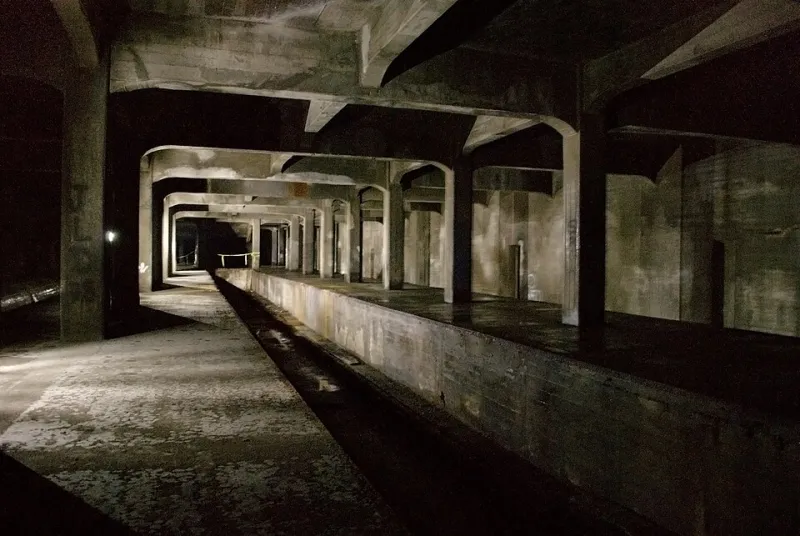
Retail Ruins: Inside the Eerie Afterlife of America's Dying Malls
Photo: CnekYT, CC BY-SA 4.0, via Wikimedia Commons
There's something deeply unsettling about walking through a shopping mall where the Muzak has finally stopped. The skylights are cracked, the fountain is dry, and a JCPenney sign hangs crooked over a space that hasn't seen a customer since the Obama administration. For a growing community of urban explorers across the United States, that feeling isn't a warning — it's an invitation.
Dead malls have quietly become one of the most compelling subgenres of urban exploration, and honestly, it makes total sense. These places were designed to feel eternal. They were supposed to be the permanent social infrastructure of American suburban life. When they fail, they fail spectacularly — and they leave behind an enormous amount of stuff.
The Rise and Fall of the American Mall
To understand why abandoned malls hit so differently than, say, a shuttered factory or a vacant hospital, you've got to understand what they meant culturally. Between the 1960s and the early 1990s, the enclosed shopping mall was the undisputed center of American suburban gravity. Developers built over 1,500 of them across the country. They were climate-controlled, endlessly walkable, and designed with a kind of optimistic grandeur that feels almost naive in retrospect.
Architecturally, most malls followed a formula pioneered by Austrian-born designer Victor Gruen — long corridors anchored at each end by major department stores, with smaller tenants filling the middle. Gruen actually hated what his concept became, but that's a whole other story. The point is, these buildings were engineered for foot traffic, not longevity. When the foot traffic stopped — thanks to e-commerce, shifting demographics, and the slow collapse of anchor tenants like Sears and Macy's — the structures themselves had no real adaptive purpose built in.
By 2024, analysts estimate that somewhere between 25 and 50 percent of American malls are either dead, dying, or in the process of being demolished. That's hundreds of locations in various states of decay, scattered across every region of the country.
What Explorers Are Actually Finding
If you've spent any time on exploration forums or YouTube rabbit holes, you've probably seen the footage. Stores still stocked with merchandise. Directory signs pointing to businesses that closed fifteen years ago. Food court tables set up like someone just stepped away for a second and never came back.
"The thing that gets me every time is the personal stuff," says one explorer from the Midwest who documents dead malls under the handle @MallWalkerGhost. "You find employee lockers with photos still inside, break room bulletin boards with shift schedules pinned up. It's like a time capsule that nobody meant to create."
That frozen-in-time quality is part of what makes these spaces so compelling from a documentation standpoint. Unlike industrial ruins, which tend to be stripped pretty aggressively for scrap, malls often sit in legal and financial limbo — ownership disputes, insurance complications, redevelopment delays — which means their interiors stay remarkably intact for years, sometimes decades.
Architecturally, there's a lot to unpack too. Many malls built in the '70s and '80s feature design elements that feel almost futuristic in their datedness: terrazzo floors in bold geometric patterns, brutalist concrete exteriors softened by interior atriums, skylights engineered to flood food courts with natural light. Seeing those design choices in a state of decay creates a genuinely surreal visual experience that photographers and filmmakers have been chasing for years.
A Regional Breakdown of Notable Dead Malls
The geography of mall abandonment roughly follows the geography of American deindustrialization, though no region is immune at this point.
The Rust Belt has arguably the densest concentration of fully abandoned malls. Ohio, Pennsylvania, and Michigan are littered with them. Rolling Acres Mall in Akron, Ohio — now partially demolished — became something of a pilgrimage site for explorers before crews moved in. Randall Park Mall in North Randolph, Ohio held the title of largest mall in the world when it opened in 1976. By the time it was finally torn down, it had become legendary in the exploration community.
The South has its own share of retail ghosts. Malls in smaller metros that got leapfrogged by suburban sprawl — places where the new outdoor lifestyle center opened five miles away and the old enclosed mall simply couldn't compete — are particularly common in states like Georgia, Tennessee, and the Carolinas.
The Midwest is home to some of the most photogenic examples, particularly in smaller cities where a single anchor tenant closing was enough to trigger a death spiral. Prairie malls with dramatic seasonal light and minimal security make for some of the most accessible exploration experiences in the country, though "accessible" is always relative.
The Northeast has fewer fully dead malls simply because real estate pressure tends to fast-track demolition or redevelopment. But there are exceptions, particularly in upstate New York and rural New England, where a handful of genuinely haunting examples still stand.
Safety, Legality, and the Ethics of the Visit
Let's be real about this part. Exploring an abandoned mall without explicit permission is trespassing, and that carries real legal consequences depending on the state you're in. Some property owners actively prosecute. Others have security patrols. A few have genuinely dangerous structural conditions — asbestos in older buildings, compromised flooring, unstable roof sections where water damage has done years of quiet work.
The urban exploration community's general code — "take nothing but photographs, leave nothing but footprints" — exists for good reasons. Vandalism and theft from these sites don't just cause legal problems for the people involved; they accelerate demolition timelines and close off access for everyone.
That said, a growing number of dead malls have found new life as legal exploration destinations. Some property owners, recognizing the interest, have started offering guided tours. Others have partnered with documentary filmmakers. If you can find a legit angle in, that's always the move.
Why We Can't Stop Looking
There's a concept in Japanese aesthetics called mono no aware — a gentle sadness about the impermanence of things. Dead malls are, in their own weird, fluorescent-lit way, a very American version of that feeling. They were built on the premise that growth was permanent, that the suburbs would keep expanding, that people would always want to drive somewhere to buy things in person. The ruins they've become are a direct argument against that premise.
For urban explorers, that makes them endlessly fascinating. Every crumbling food court and every shuttered Spencer's Gifts is a document of a very specific moment in American cultural history — and once the demolition crews arrive, that document is gone forever.
The people out there photographing these spaces aren't just thrill-seekers. A lot of them are historians operating without an institutional budget, preserving visual records of places that nobody else thought were worth saving. That feels like meaningful work, even when it's technically illegal.
So yeah. The mall might be dead. But the conversation about what it meant — and what it looks like now — is very much alive.