Clocked Out Forever: What Explorers Find on the Factory Floors America Left Behind
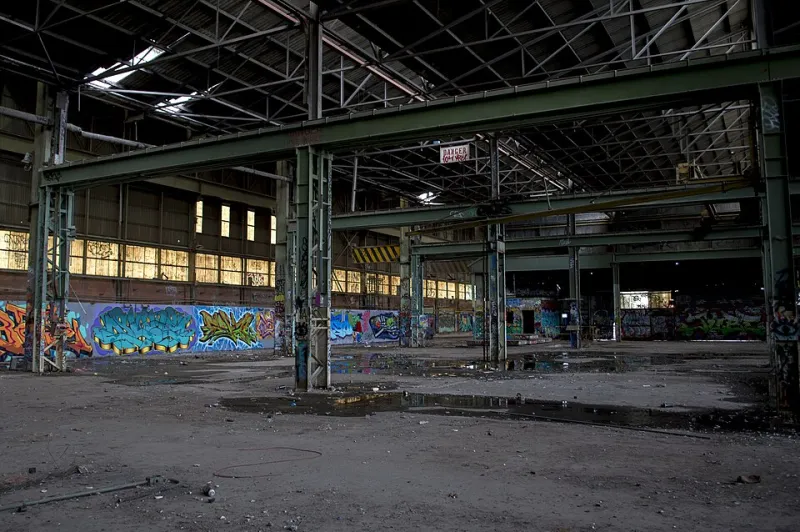
Photo: Solarence, CC BY-SA 4.0, via Wikimedia Commons
The time clock is still mounted by the door. It's a heavy, institutional thing — the kind with a mechanical arm that stamps your card when you punch in — and it's been sitting in the same spot since the last shift ended somewhere in the mid-1980s. The time cards are still in the rack beside it, each one labeled with a worker's last name in faded ink. Nobody punched out. They just stopped coming.
This is the texture of abandoned American manufacturing, and it hits differently than other kinds of ruins. There's a specific weight to a factory floor that's been sealed up with everything still inside — the tools on the pegboards, the safety posters on the walls, the coffee cup on the supervisor's desk. These places weren't cleared out. They were left. And the distinction matters enormously when you're standing in the middle of one, trying to understand what actually happened here.
The Scale of What Was Lost
The numbers are almost too large to process. Between 1979 and 2010, the United States lost roughly one-third of its manufacturing jobs — somewhere in the neighborhood of 7 to 8 million positions, depending on how you count. The physical infrastructure that supported all of that work didn't disappear with the jobs. It just sat there. Steel mills, auto assembly plants, textile mills, foundries, glass manufacturers, rubber plants — the built footprint of American industrial production is enormous, and a significant chunk of it has been sitting empty for decades.
The Rust Belt gets most of the attention, and for good reason. Cities like Detroit, Cleveland, Pittsburgh, Gary, and Youngstown contain some of the most dramatic and historically significant abandoned industrial sites in the country. But the phenomenon isn't geographically contained. Textile mill abandonment hit the Carolinas and New England hard. Paper mills dot the Pacific Northwest. Food processing plants and meatpacking facilities haunt the Great Plains. The geography of American deindustrialization is national, even if the conversation about it tends to focus on a handful of Midwestern cities.
Reading the Floor
Experienced industrial explorers develop a specific kind of literacy for factory spaces. The layout of a plant tells you things about its era and its industry before you've found a single document or artifact. Early 20th-century factories tended to be multi-story, built before the horizontal flow of assembly-line production became standard — you can read the logic of gravity-fed manufacturing in the stairwells and freight elevators. Post-war plants sprawl outward instead of upward, single-story behemoths built around moving product efficiently from one end to the other.
Machinery is often the most legible text in these spaces. Explorers who know what they're looking at can identify the industry, approximate the era, and sometimes even the specific products being made just from the equipment left behind. A loom is a loom. A blast furnace is unmistakable. The specific configuration of a stamping line tells you something about what was being stamped. In auto plants, the ghosts of specific vehicle models are sometimes visible in the tooling — fixtures and jigs machined to fit one particular body panel, now sitting on the floor of a plant that hasn't made anything in thirty years.
The Personal Archaeology
The human layer is what pulls most explorers to these sites. Factories were intensely social environments — people spent entire careers in the same building, often following parents and siblings into the same plant, sometimes working the same machines. That density of human experience leaves traces.
Lockers are perhaps the most affecting finds. In many abandoned plants, the employee locker rooms were simply locked up and left, their contents intact. Explorers have documented personal photographs taped to locker doors, work boots still on the bottom shelf, union cards and pay stubs tucked into the frame of a mirror. One well-documented exploration of a former auto parts plant in Michigan turned up a locker with a child's drawing still pinned inside — crayon on construction paper, the kind of thing a kid hands their parent and says to put somewhere safe.
Break rooms and cafeterias preserve their own kind of time capsule. Vending machines with price stickers from decades past. Bulletin boards layered with notices — safety reminders, union meeting announcements, lost-and-found postings, someone's handwritten ad for a used truck. The administrative areas often yield the most documentation: personnel files, production records, maintenance logs, correspondence. Some explorers have spent hours in former plant offices reading through the paper record of a company's final years, watching the orders slow down and the layoff notices multiply.
What Stays, What Goes
Not everything survives. Scrappers have hit most significant industrial sites at least once, and the valuable metals — copper wiring, aluminum fixtures, certain grades of steel — tend to disappear quickly after a plant closes. What remains is usually what was too heavy, too embedded, or too worthless to bother with. Massive machine tools that would cost more to remove than they'd bring at scrap. Concrete infrastructure. The bones of the building itself.
In some plants, the removal of copper wiring has left the electrical systems gutted in ways that make the remaining machinery look almost anatomical — stripped of its nervous system, just the skeleton and muscle of steel and iron sitting in the dark. The damage from scrapping is itself a kind of documentation: you can read where the valuable material was, and therefore understand something about how the building functioned, from the negative space left behind.
Preservation and the Cities Left Holding the Bill
What do you do with a million-square-foot steel mill when the steel company walks away? That question is playing out in real time across dozens of American cities, and there are no easy answers. Demolition is expensive — industrial buildings are built to last, and bringing them down safely costs money that cash-strapped municipalities often don't have. Remediation of environmental contamination, which is nearly universal in heavy industrial sites, adds another layer of cost and complexity.
Some sites have found creative second lives. The transformation of Pittsburgh's industrial waterfront, or the ongoing redevelopment of former mill sites in places like Bethlehem, Pennsylvania, shows what's possible with the right combination of public investment, private development interest, and historical preservation advocacy. Adaptive reuse — converting factory buildings into loft apartments, maker spaces, breweries, or arts venues — has become a standard playbook in cities with strong real estate markets.
For every Bethlehem Steel site that gets a museum, though, there are dozens of smaller plants in smaller cities that sit in legal and financial limbo, too contaminated to develop cheaply and too significant to simply knock down. They become de facto time capsules, which is exactly why explorers keep finding them.
Going In
Industrial sites carry real hazards that go beyond the usual abandoned-building risks. Asbestos insulation was standard in factories built before the 1980s and is still present in enormous quantities at many sites. Chemical contamination — solvents, heavy metals, process chemicals — can be present in soil, standing water, and even dust. Structural instability is common, particularly in older multi-story plants where the floor systems were designed to carry production equipment loads and have been degrading for decades without maintenance.
None of that stops explorers from going in, nor should it stop you from learning about these places. But it does mean that responsible exploration here requires more preparation than most other site types. Research the industrial history of the site before you visit. Understand what was made there and what chemicals that process involved. Bring proper respiratory protection. Tell someone where you're going.
The stories embedded in these floors are worth finding. The people who worked these plants deserve to have their world documented before it disappears entirely. Just make sure you come home to tell what you found.