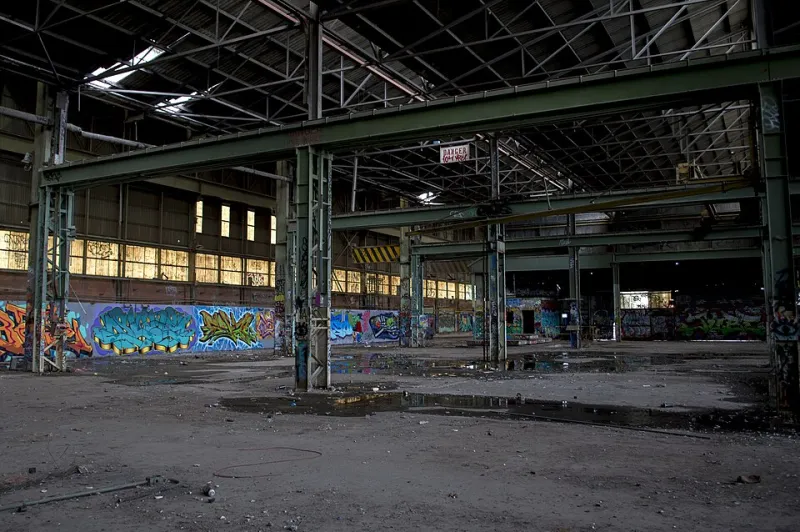
Last Feature Showing: Wandering the Overgrown Drive-In Theaters America Forgot
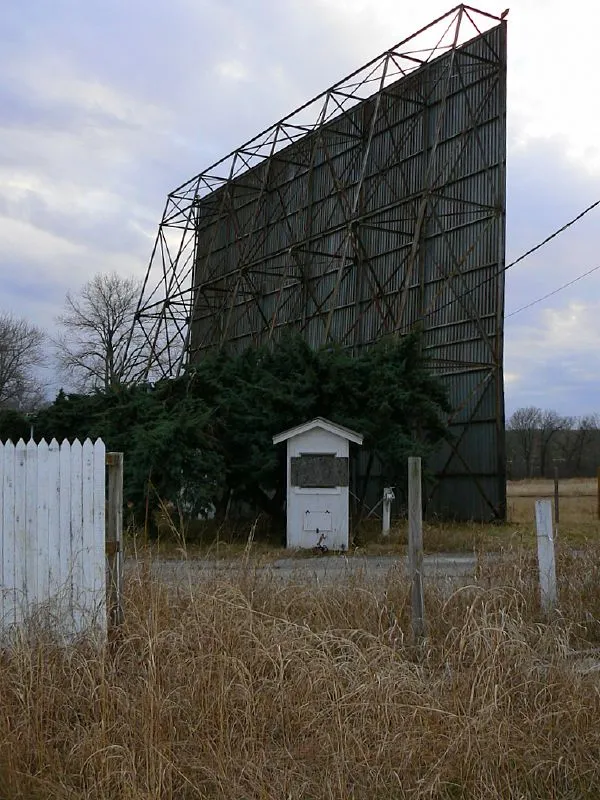
Photo: Thomas & Dianne Jones from Okmulgee, USA, CC BY 2.0, via Wikimedia Commons
There's something uniquely disorienting about standing in the middle of a drive-in theater at noon on a Tuesday. The rows of rusted speaker poles are still perfectly spaced, waiting for cars that stopped arriving sometime in the late '90s. The screen — maybe four stories tall, maybe more — looms at the far end of a field that's half gravel, half weeds. Somewhere behind you, a projection booth sits padlocked and peeling. You didn't come for a movie. You came because this place has been calling to you from Google Maps for months, just sitting there in the satellite view like a scar nobody bothered to explain.
Drive-in theaters were everywhere once. At their peak in 1958, the US had over 4,000 of them scattered from Vermont to Southern California, from small Kansas towns to the outer rings of every major metro area. By 2023, fewer than 300 remained operational. The rest? They're out there on the backroads, slowly disappearing into the landscape. And urban explorers have been finding them, one rusted marquee at a time.
How the Curtain Came Down
The decline wasn't sudden — it played out over decades in slow motion. The 1970s energy crisis hit drive-ins hard since their whole business model depended on people driving cars, idling engines, and running heaters. Then came the VCR, then cable, then the multiplex boom of the '80s that turned indoor theaters into palaces with stadium seating and Dolby sound. Drive-ins couldn't compete on any of those fronts.
But the real killer was real estate. Drive-ins sat on enormous parcels of flat, accessible land right at the edges of expanding suburbs — exactly the kind of property developers were desperate for. Thousands of sites got bulldozed for strip malls, housing developments, and big-box retail. The ones that survived were usually in places nobody wanted to develop: rural counties, economically depressed towns, or patches of land with complicated ownership histories. Which, conveniently, is exactly where explorers tend to find them.
What You Actually Find Inside
Every abandoned drive-in has its own personality, but a few things show up again and again. The snack bar is almost always the most intact structure on the property. Built to last, usually out of cinder block, these little buildings were the financial engine of the whole operation — drive-ins made most of their money on concessions, not admissions. Explorers routinely find vintage popcorn machines, ancient soft-serve dispensers, and hand-painted menu boards still advertising 25-cent hot dogs and 10-cent candy bars.
Ticket booths are another consistent find. Small, often octagonal, and positioned right at the entrance lane, they're usually in rough shape but still recognizable. Some still have the pricing structure posted inside the window. Others have old ticket rolls jammed in the dispenser, the kind of detail that hits harder than you expect when you're actually standing there holding one.
The projection booths are the holy grail for most explorers. Access is often tricky — lots of padlocks, lots of rotted stairs — but getting inside is worth it. These rooms were built around enormous carbon-arc or xenon projectors that weighed hundreds of pounds, and many of those machines are still there because nobody could figure out how to remove them economically. Film reels, splicing equipment, and maintenance logs sometimes survive alongside the hardware. One explorer documented a 1983 film schedule still tacked above a work bench at an abandoned site in rural Ohio, the showtimes written in ballpoint pen on a piece of notebook paper.
The Screen Itself
Nothing at an abandoned drive-in prepares you for the scale of the screen up close. From a distance, it just looks like a big rectangle. Up close, it's architectural. The screens were built on steel or wooden frameworks designed to withstand decades of wind, and many of them have — even without maintenance. The painted surface, usually some kind of whitewash or specialized reflective coating, weathers in fascinating patterns. Vines climb the support structures. Birds nest in the upper framework. The whole thing becomes something between a billboard and a ruin.
Some screens have partially collapsed, leaving skeletal frameworks standing like industrial sculpture. Others are remarkably intact. A few sites in the South and Southwest still have their original signage attached — neon-trimmed marquees spelling out theater names in chunky mid-century fonts, the kind of lettering that design people lose their minds over. When those signs are still standing, still readable, the effect is genuinely eerie. Like the place is still advertising for a show that never got cancelled, just indefinitely postponed.
The Human Archaeology
What makes drive-in exploration different from poking around a factory or a hospital is the intimacy of what gets left behind. These were places where families spent Friday nights, where teenagers went on first dates, where people watched movies from the back seats of station wagons with kids asleep under blankets. The detritus reflects that. Explorers have found children's shoes under speaker poles, old candy wrappers embedded in the gravel, and in one memorable case, a complete set of vintage lawn chairs still arranged in front of a speaker pole at a Missouri site, as if someone stepped away to get a refill and just never came back.
Employee areas tell their own stories. Break rooms with old coffee makers and union notices still pinned to corkboards. Storage rooms packed with drive-in-specific equipment — those in-car speakers, the FM transmitter rigs that replaced them in later years, spare projection parts in cardboard boxes gone soft with moisture.
Preservation vs. Decay
A small number of abandoned drive-in sites have found second lives. Some have been converted into flea markets or swap meets, which actually works surprisingly well given the existing infrastructure. A handful have been restored to operational status by preservation-minded owners, though that's an expensive and complicated process. Historic preservation advocates have pushed for landmark status at a few high-profile sites, with mixed results.
For most of them, though, the future is uncertain at best. The screens are the most vulnerable elements — they require ongoing maintenance to stay upright, and once they start going, they go fast. The concrete pads and speaker poles can last for generations. The screens usually can't.
Finding Them
Drive-in theater databases exist online and are a good starting point — several enthusiast communities have mapped both operational and closed sites across the country. Satellite imagery does the rest. The footprint of a drive-in is unmistakable from above: that fan-shaped arrangement of parking rows, the central projection booth, the screen position. Once you know what you're looking for, you start seeing them everywhere.
As always, check access and ownership before you visit. Many of these properties are privately held, and some are actively monitored even if they appear completely abandoned. The goal is to document, not to disturb — these places have already lost enough.