Concrete and Corridors: Inside America's Abandoned Brutalist Hospitals and Asylums
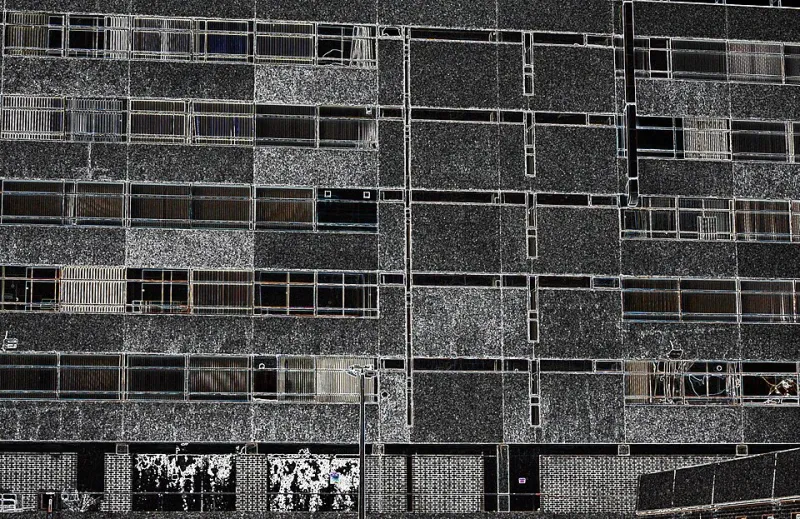
Photo: Conall from Downpatrick, Northern Ireland, CC BY 2.0, via Wikimedia Commons
There's a particular feeling you get standing at the entrance of an abandoned hospital. It's not quite the same as any other derelict building. Factories feel industrial in their emptiness. Schools feel melancholy. But hospitals — especially the big, severe ones built between the 1950s and 1980s — feel loaded. Like the air itself hasn't fully exhaled since the last patient left.
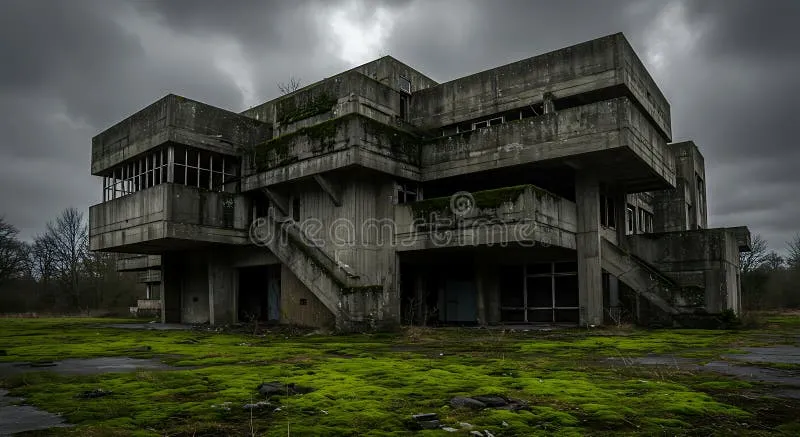
When that hospital happens to be brutalist — and a surprising number of them are — the effect compounds. Brutalism doesn't soften with age the way other architectural styles do. It just gets more itself: heavier, more angular, more insistent. An abandoned brutalist hospital doesn't look like it's decaying so much as it looks like it's waiting.
This guide is for explorers who want to understand this category of site before they approach one. What these buildings are, why so many of them are empty, what you'll find inside, and what the architecture itself is actually telling you.
Why So Many Hospitals Got Left Behind
The wave of hospital closures and psychiatric institution shutdowns that swept the country from the late 1970s through the early 2000s was driven by a convergence of forces that had very little to do with the buildings themselves.
Deinstitutionalization — the policy shift that moved patients out of long-term psychiatric facilities and into community-based care — began in earnest in the 1960s and accelerated through the 1980s. The Community Mental Health Act of 1963 set the framework, and subsequent decades of budget cuts gutted the community support systems that were supposed to replace institutional care. The result: massive psychiatric campuses across the country were systematically emptied, often faster than any realistic plan for the buildings existed.
State-run psychiatric hospitals were particularly affected. Facilities like the sprawling Greystone Park Psychiatric Hospital in New Jersey (partially demolished, partially still standing) or the Danvers State Hospital in Massachusetts (now partially converted to condos, with significant portions still derelict) were built in an era when psychiatric care meant long-term, campus-style residential treatment. When that model collapsed, the buildings — often spread across hundreds of acres — had no obvious next use.
General hospitals faced a different but equally disruptive set of pressures: Medicare and Medicaid reimbursement changes, the shift toward outpatient care, rural population decline, and the consolidation of healthcare systems into regional networks. Smaller county and municipal hospitals were simply outcompeted, and many of the buildings that housed them were too expensive to retrofit and too architecturally distinctive to easily repurpose.
The Brutalist Connection
It's worth asking why so many abandoned hospitals are brutalist in the first place.
The answer is timing. The postwar expansion of American healthcare infrastructure — driven by the Hill-Burton Act of 1946, which funded hospital construction across the country — coincided almost perfectly with the rise of brutalism as the dominant architectural language for institutional buildings. Brutalism suited hospitals conceptually: it emphasized function, it projected authority and permanence, and its heavy concrete construction was genuinely durable.
Architects also found something philosophically appealing about brutalism's honesty. Exposed concrete doesn't pretend to be anything other than what it is. For a building type that dealt in life and death, there was a certain integrity to that directness.
The irony, of course, is that brutalism's institutional associations — the very qualities that made it seem appropriate for hospitals — also made these buildings incredibly difficult to adapt once medicine moved on. Nobody wants to live in a building that looks like a county jail. Nobody wants to open a boutique hotel in a structure that screams "psychiatric ward." So the buildings sit.
What You Actually Find Inside
The documentation coming out of abandoned hospital explorations is some of the most visually striking in the urban exploration world, and for good reason. These sites tend to be preserved in a way that more heavily scavenged locations aren't — partly because of their isolation, partly because of the legal and psychological barriers that keep casual trespassers away.
Explorers consistently report finding:
Medical equipment left in place. Exam tables, operating lights, X-ray equipment, pharmacy fixtures. In some facilities, entire wards appear to have been abandoned mid-operation, with equipment still positioned as if waiting for the next patient. This is partly a function of how expensive and specialized medical equipment is to remove — sometimes it simply wasn't worth the logistics.
Paper records. This is where things get ethically complicated. Patient records, staff files, and administrative documents are frequently found in abandoned psychiatric facilities, often in quantities that suggest a chaotic rather than planned closure. Explorers are generally careful about how they document and share this material, and the responsible approach is to avoid publishing anything that could identify former patients.
Institutional infrastructure at scale. Brutalist hospitals are big in a way that photographs struggle to convey. Long corridors that seem to converge toward infinite vanishing points. Stairwells that drop through six or eight floors of identical concrete landings. Cafeterias designed to feed hundreds. The scale alone is disorienting.
Signage and wayfinding systems. Old hospital signage — the color-coded department markers, the room numbering systems, the cautionary notices — survives remarkably well. It's some of the most evocative material in these buildings, because it's so specifically functional. "Quiet Please." "No Visitors Beyond This Point." "Restricted Area."
The Architecture as Document
Spending time in an abandoned brutalist hospital is, among other things, an education in how a particular era thought about human care.
The design philosophy embedded in these buildings — the long corridors that allowed staff to observe multiple rooms simultaneously, the centralized nursing stations, the separation of patient populations into distinct wings — reflects a model of healthcare that has been substantially revised since these structures were built. Walking through them, you can read the assumptions in the architecture: assumptions about privacy, about the relationship between patients and staff, about what healing was supposed to look like.
Some of those assumptions were wrong, and the history of American psychiatric care in particular includes periods of genuine abuse and neglect. Sitting with that history in a physical space — rather than reading about it abstractly — is a different kind of encounter with the past.
Practical Considerations for Serious Explorers
Abandoned hospitals present a specific and serious set of hazards that deserve direct attention.
Asbestos is nearly universal in buildings of this era. Friable asbestos — the kind that's actually dangerous when disturbed — is commonly found in floor tiles, pipe insulation, ceiling materials, and HVAC components in facilities built before the late 1970s. A proper N95 or P100 respirator is not optional in these environments. Neither is minimizing dust disturbance.
Biological hazards are also a legitimate concern. Abandoned medical facilities may contain sharps, pharmaceutical residue, and in some cases, biological material that was never properly disposed of during closure. Thick gloves and situational awareness are basic requirements.
Structural integrity varies enormously. Brutalist concrete construction is generally more durable than wood-frame or brick buildings, but decades of water infiltration — especially in northern climates with freeze-thaw cycles — can compromise even substantial concrete structures in ways that aren't visible from the surface.
Legal exposure is significant. Many of these facilities are on private property with active security. The consequences for trespassing on healthcare-adjacent property can be more serious than at other abandoned sites, particularly if the property is still nominally in use for storage or administrative purposes.
As always: research thoroughly, go with experienced people, tell someone where you are, and treat what you find with the respect it deserves. These weren't just buildings. They were places where people went through some of the hardest moments of their lives. The least we can do is document them carefully.