Escalators to Nowhere: What Explorers Find Deep Inside America's Abandoned Department Store Giants
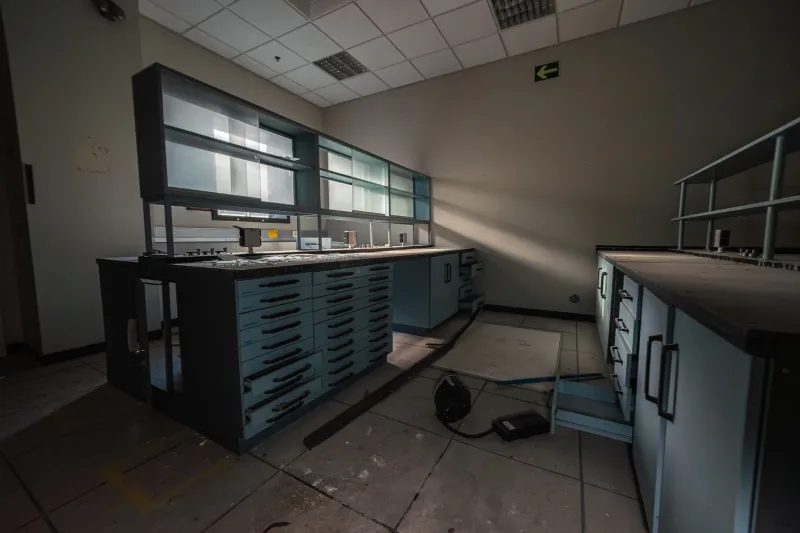
There's a particular kind of silence you only find inside a dead department store. It's not the silence of an empty field or an abandoned warehouse. It's something thicker — the silence of a place that was designed for noise, for crowds, for the constant hum of commerce — and got none of it. Fluorescent tubes still dangle from drop ceilings. Circular clothing racks sit mid-floor like skeletal carousels. Somewhere in the back, a dressing room mirror still reflects a version of America that doesn't exist anymore.
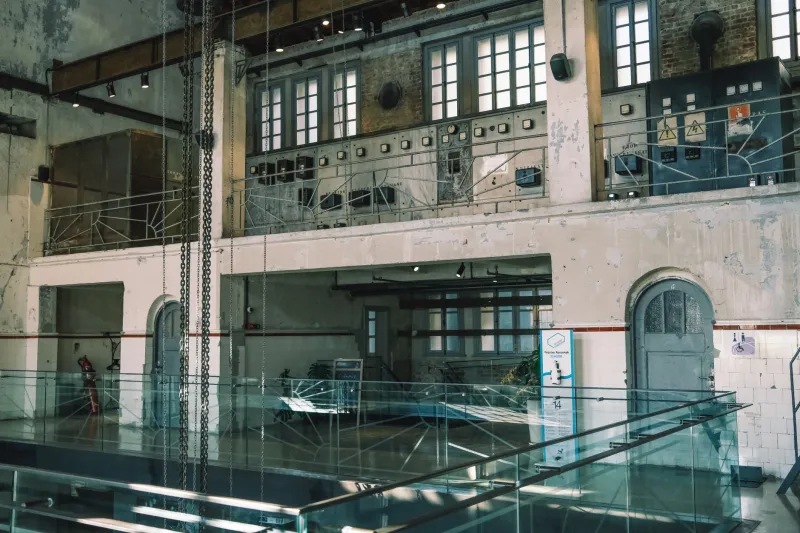
For urban explorers, these abandoned retail giants have become some of the most compelling — and most logistically challenging — sites on the map. They're massive. They're layered. And they're absolutely packed with the architectural and cultural residue of mid-century American consumer life.
Built to Impress, Designed to Last
The department stores that urban explorers are now crawling through weren't built cheap. From the 1940s through the 1980s, regional chains like Hecht's, Mervyn's, Caldor, Ames, and dozens of others constructed anchor stores that were meant to anchor communities — not just strip malls. These buildings were statements.
Walk into one today and the bones still tell that story. Terrazzo floors, cracked but intact, run the length of ground-level cosmetics sections. Ornate plaster ceiling medallions — holdovers from earlier renovations — peek out from behind collapsed drop-ceiling tiles. Brass fixtures on display cases have oxidized to a dull green. The architecture of these spaces was deliberately aspirational, and even in decay, that aspiration is hard to miss.
Many explorers note that the first floor tends to be the most photogenic. This was always the prime retail real estate — perfume, jewelry, handbags — and it got the most design attention. Upper floors, dedicated to housewares or hardware or sporting goods, often feel more industrial by comparison. But they have their own rewards.
The Escalator Problem
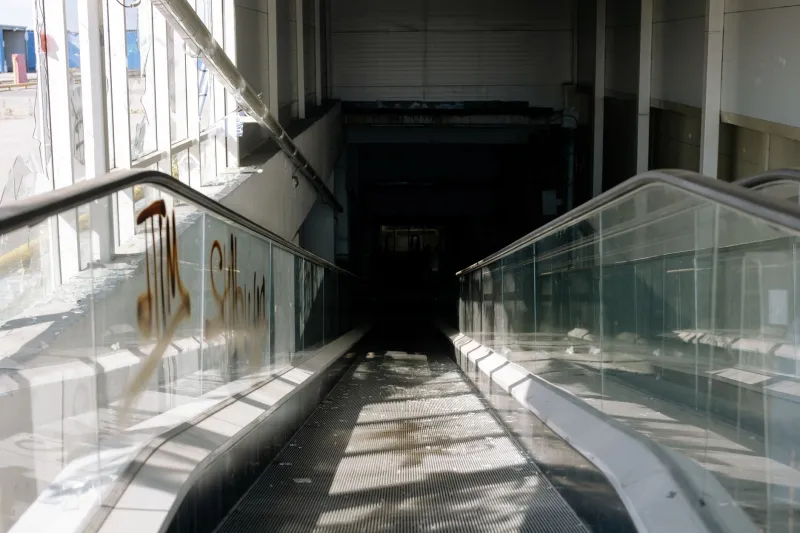
Ask any explorer who's spent serious time in these buildings, and they'll tell you: the escalators are the heart of the experience. These weren't just functional conveyances. They were theater. Gleaming chrome handrails, wide enough to feel luxurious. Steps that clicked and groaned and carried you upward past seasonal displays and promotional banners.
Frozen mid-flight — which is how most explorers find them — escalators become something else entirely. They're staircases now, steep and slightly uneven, with the mechanical guts visible through gaps in the casing. In stores that have been sealed for years, the grease on the escalator mechanisms has hardened into a kind of archaeological layer. Some explorers have documented escalators still partially loaded with merchandise that never made it to the sales floor — a surreal still life of retail logistics interrupted.
The upper floors accessible by these frozen escalators often hold the strangest discoveries. Stock rooms. Break rooms with motivational posters still thumbtacked to corkboards. Training manuals for sales associates. One explorer documenting a former Midwestern department store found an entire floor that appeared to have been mid-renovation when the store closed — walls half-demolished, new flooring samples still stacked in a corner, a contractor's estimate stapled to a doorframe.
Executive Country: The Upper Office Floors
What a lot of people don't realize about these old department store buildings is how much square footage was dedicated to corporate infrastructure. These weren't just retail spaces — they were mini-headquarters. Upper floors, often inaccessible to shoppers, housed HR departments, accounting offices, regional management suites, and in larger flagship stores, entire executive floors with private dining rooms and dedicated elevator banks.
These spaces are consistently among the most striking finds for explorers. The contrast between the consumer-facing floors below and the corporate floors above is jarring. Down on three, you've got shag carpet and circular clothing racks. Up on six, you've got mahogany paneling, private bathrooms with full tile work, and conference rooms with leather chairs still arranged around oval tables.
Paperwork is almost always present. Memos. Personnel files. Sales projections from fiscal years that are now decades past. In some stores, explorers have found detailed architectural drawings for expansions that were never built — a ghost version of the building layered on top of the real one.
The Basement: Where Things Get Interesting
If the executive floors are the most visually striking part of these explorations, the basement systems are the most mechanically fascinating. Department stores of this era relied on extensive subterranean infrastructure — and it's largely still down there.
Pneumatic tube systems, used to shuttle cash and receipts between registers and central accounting, snake through basement ceilings like industrial vines. Conveyor systems for moving stock from receiving docks to the sales floor sit rusted and still. Boiler rooms the size of small houses contain equipment that would look at home in a submarine. In stores with multiple basement levels — not uncommon in urban flagship locations — explorers can descend through layers of increasing industrial complexity, moving from stockrooms to mechanical rooms to utility tunnels that sometimes connect to neighboring structures or even city infrastructure.
The receiving docks, usually at the back of the basement level, are often where the most poignant artifacts cluster. Unopened boxes. Inventory manifests. Handcarts still loaded with merchandise that was waiting to go upstairs when everything stopped. It's the department store equivalent of Pompeii — a moment of ordinary commercial life, interrupted and preserved.
Reading the Retail Archaeology
What makes these spaces so compelling beyond the visual drama is what they tell us about a very specific chapter of American economic and cultural history. The department store megaplex was a product of postwar prosperity, suburban expansion, and a particular model of consumer culture that assumed continuous growth. These buildings were built with the confidence of institutions — the confidence of places that expected to be around forever.
The layers of renovation visible inside them tell that story in reverse. Strip back a drop ceiling and you find the original plasterwork from the 1950s opening. Pull up linoleum and there's the original terrazzo. Each renovation layer is a decade, a redesign, a new management team with a new vision for how to keep customers coming through the doors. The final layer — whatever was in place when the store closed — is just the last chapter of a longer story.
Explorers who take time with these sites often describe them as emotionally complex in a way that pure industrial ruins aren't. Factories are about labor. Department stores are about aspiration — about the particular American promise that comfort and beauty and abundance were available to anyone who walked through the door. Finding that promise frozen and abandoned hits differently.
Getting In, Getting Around
A quick practical note for anyone considering these sites: abandoned department stores present some specific challenges. The sheer square footage means it's easy to get disoriented, especially in basement levels where natural light is nonexistent. Many of these buildings have been partially stripped by scrappers, which means floor sections can be compromised and electrical systems unpredictable. Asbestos-containing materials were standard in construction through the mid-1970s, so respiratory protection isn't optional in older structures.
On the upside, these buildings are often well-documented online — former employees, local historians, and previous explorers have frequently published detailed accounts that can help you understand the layout before you ever set foot inside.
The abandoned department store megaplex is, in many ways, the perfect urban exploration site: architecturally rich, historically legible, and strange enough to feel genuinely otherworldly. The escalators go nowhere now. But they'll take you somewhere, if you let them.