Dead Experiments: What Urban Explorers Find Inside America's Abandoned Research Labs
There's a particular kind of silence that lives inside an abandoned laboratory. It's not the quiet of an empty office building or a shuttered shopping mall. It's heavier than that — more deliberate. These were spaces engineered for precision, for controlled environments, for the elimination of outside interference. When the funding dried up or the company folded or the government contract ended, that engineered stillness just... stayed. And now explorers are walking through it.
Across the United States, dozens of research campuses, government science stations, biotech facilities, and aerospace testing centers sit locked, fenced off, or simply forgotten. Some were abandoned overnight. Others wound down slowly over years before the last light got switched off. What they left behind is unlike anything else in the urban exploration world — a category of ruin that feels less like decay and more like a pause button that nobody ever came back to hit play on.
The Pharmaceutical Ghost Towns
Some of the most accessible — and most photographed — abandoned research spaces in the country are former pharmaceutical campuses. The consolidation wave that swept through the drug industry in the late 1990s and 2000s left a trail of shuttered R&D facilities stretching from New Jersey to California. When a big pharma company absorbed a smaller competitor, it rarely needed two research headquarters. One of them got locked up.
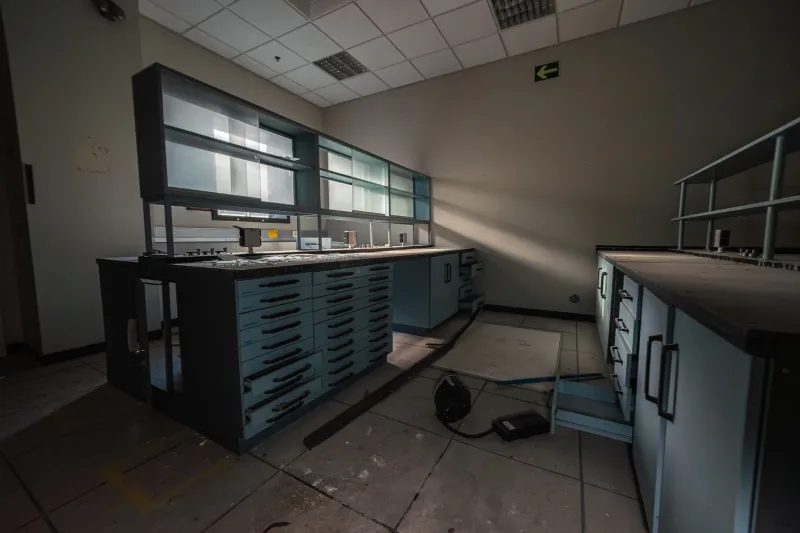
What explorers find inside these places tends to follow a pattern: rows of stainless steel lab benches still bolted to the floors, fume hoods with their sashes halfway open, and storage rooms packed with bottles of reagents that have long since expired or crystallized. The paperwork is often remarkable. Binders full of trial protocols, compound logs, and internal memos get left behind in file rooms, sometimes still neatly organized on shelves as if someone expected to come back Monday morning.
The cafeterias in these facilities are a strange bonus — big institutional spaces with motivational posters still on the walls and coffee machines that look like they could almost be plugged back in. The contrast between the clinical precision of the labs and the mundane humanity of the break rooms is part of what makes these places so compelling to document.
Aerospace and the Architecture of Ambition
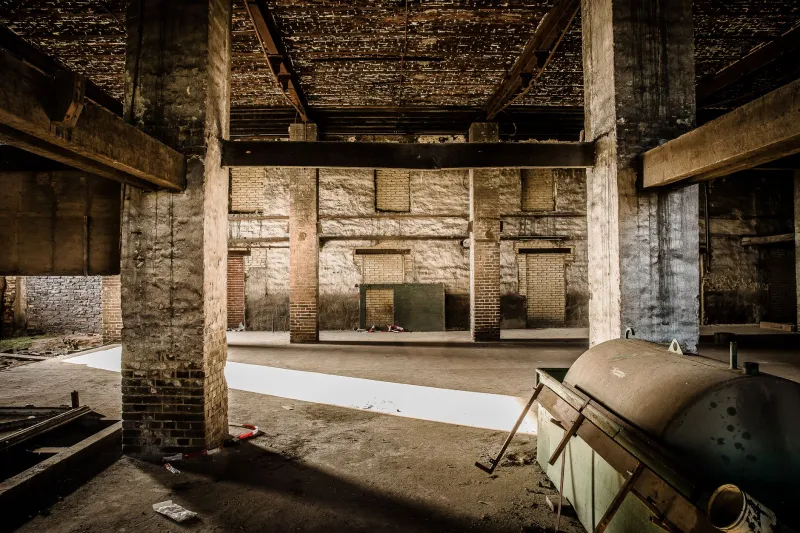
Government-adjacent aerospace research facilities carry a different energy entirely. These are places where the scale of ambition was written into the architecture itself — wind tunnels the size of airplane hangars, anechoic chambers lined floor-to-ceiling with foam spikes, test stands built to hold rocket engines. When programs got cancelled or funding shifted, some of this infrastructure simply got abandoned in place because dismantling it would cost more than leaving it standing.
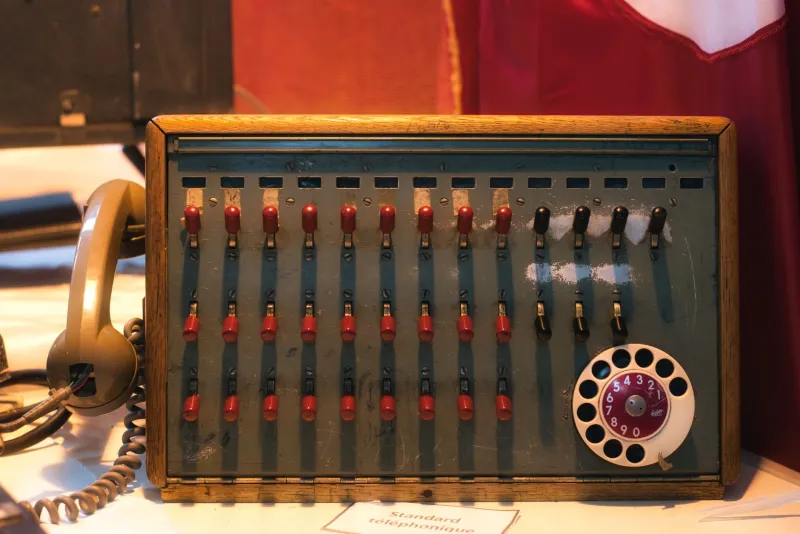
Several former NASA contractor facilities and Air Force research annexes across the Midwest and Southwest have become well-known stops on the exploration circuit. The machinery in these places is often enormous and bewildering — purpose-built equipment that served one very specific function for one very specific program and has no practical use to anyone now. Explorers report finding rooms full of analog instrumentation panels, walls of dials and switches that monitored tests that happened decades ago, still wired to nothing.
Classified signage is common. So are rooms that have been partially cleared out, with the ghost outlines of removed equipment still visible on dusty floors — perfect rectangular clean patches where something important used to sit before someone came back for it.
The Biotech Boom's Leftovers
The biotech bubble of the early 2000s left its own footprint. Startup companies that raised enormous amounts of venture capital built out gleaming research facilities in places like Research Triangle Park in North Carolina, the biotech corridors of San Diego, and the suburban campuses outside Boston. When the money ran out or the science didn't pan out, some of those facilities sat empty for years before being repurposed — and a handful never were.
These spaces tend to feel newer than your typical ruin, which creates its own unsettling quality. Drop ceilings, modular lab furniture, and card-reader security systems that still blink their little green or red lights even though the building they're protecting has been empty for a decade. Explorers in these facilities often describe a feeling of incompleteness — like walking through a film set where production shut down before they finished building the world.
Biosafety cabinets. Incubators. Ultra-cold freezers that have long since thawed out and been left propped open. The detritus of molecular biology is everywhere, and while none of it is particularly dangerous at this point, the presence of biohazard signage on doors and disposal containers tends to give even experienced explorers a moment of pause.
What the Whiteboards Remember
If you ask explorers what sticks with them most after visiting an abandoned lab, a surprising number of them mention the whiteboards. Lab spaces live and die by their whiteboards — they're where hypotheses get sketched out, where experimental designs get argued over, where someone draws a diagram to explain something to a colleague who just doesn't get it yet. And in abandoned facilities, those boards often never got erased.
Partial equations. Flowcharts for processes that were never completed. Someone's name circled with an arrow pointing to a task that was apparently assigned to them on the last day anyone was paying attention. These fragments of scientific thought, frozen mid-sentence, carry a weight that's hard to articulate. They're evidence of minds at work — and then, suddenly, not.
Practical Notes for the Curious
A few things worth knowing before you go chasing these kinds of locations. First, hazard awareness matters more here than in most abandoned spaces. Old chemical storage areas can contain genuinely dangerous materials, and certain types of research facilities — particularly those that handled radioactive isotopes or certain biological agents — may have contamination concerns that aren't visible or obvious. Research the history of a facility carefully before entering. Government databases and old news coverage are your friends here.
Second, the legal situation around these facilities tends to be more complicated than your average abandoned building. Many former government research stations sit on federal land, and some pharmaceutical and biotech campuses are still technically owned by active corporations that just haven't done anything with them yet. Trespassing consequences can be significant.
That said, for the explorer willing to do the homework, few categories of abandoned space offer this kind of density of storytelling. Every room in a research facility was built for a purpose, and the artifacts those rooms leave behind are specific, strange, and deeply human. These were places where people tried to figure things out — and the evidence of that effort doesn't disappear just because the funding did.
The experiments may be dead. But the questions they were asking are still written on the wall.