Dial Tone Graveyards: What Explorers Find Inside America's Abandoned Telephone Exchanges
Somewhere in most American cities, there's a building that doesn't quite make sense. It's usually mid-block, often windowless on the upper floors, built with more architectural ambition than the neighborhood around it ever seemed to warrant. The stonework is too detailed. The lobby — if there is one — is too grand. There's no obvious signage, no clear purpose, and nobody going in or out. If you've ever noticed one of these places and wondered what the deal was, there's a decent chance you were looking at a telephone exchange.
For urban explorers who've stumbled into one of these structures, the experience tends to stick with them. These weren't just office buildings. They were temples to a very specific kind of mid-century engineering optimism — the belief that human connection could be systematized, routed, switched, and scaled indefinitely. Walking through one today feels less like entering an abandoned building and more like stepping into the nervous system of a civilization that quietly moved on without bothering to clean up after itself.
The Architecture of Connection
Telephone exchange buildings — sometimes called central offices or wire centers — were purpose-built facilities designed to house the mechanical and, later, electronic infrastructure that routed calls between subscribers. AT&T and its regional Bell System affiliates constructed hundreds of these across the country between roughly the 1920s and the 1980s, and the buildings reflect the aesthetic sensibilities of whoever was holding the architectural contracts at the time.
The earlier ones, built during the art deco boom of the late 1920s and 1930s, are genuinely stunning. Facades dressed in terracotta ornament, geometric friezes, and stylized reliefs of telephone operators or lightning bolts were common. The New York Telephone Company alone commissioned several of these showpieces across Manhattan and the outer boroughs, treating their exchange buildings as visible symbols of corporate modernity. Lobbies featured marble floors, brass fixtures, and vaulted ceilings — all for a building most customers never entered.
By the postwar era, the aesthetic shifted hard toward brutalism. Exchange buildings from the 1950s through the 1970s tend to be fortress-like concrete slabs, deliberately windowless to protect sensitive equipment from electromagnetic interference and to maintain stable internal temperatures. They look imposing and slightly hostile from the street, which was partly the point. These were critical infrastructure nodes, and the phone company wanted them to feel impenetrable.
What's Still Inside
Explorers who've accessed decommissioned telephone exchanges consistently report the same initial impression: the scale of the cable infrastructure is genuinely hard to process in person. These buildings were threaded floor-to-ceiling with copper wire — hundreds of thousands of individual pairs bundled into massive trunk cables, routed through cable trays, punch-down blocks, and distribution frames that stretch the full height of multi-story equipment rooms.
The wire doesn't just hang there, either. It was organized with obsessive precision. Color-coded insulation, labeled terminal blocks, hand-written cable schedules tacked to wooden frames — the evidence of countless hours of meticulous human labor is still visible in buildings that haven't been touched in decades. Some explorers describe it as walking through a three-dimensional circuit diagram that fills an entire city block.
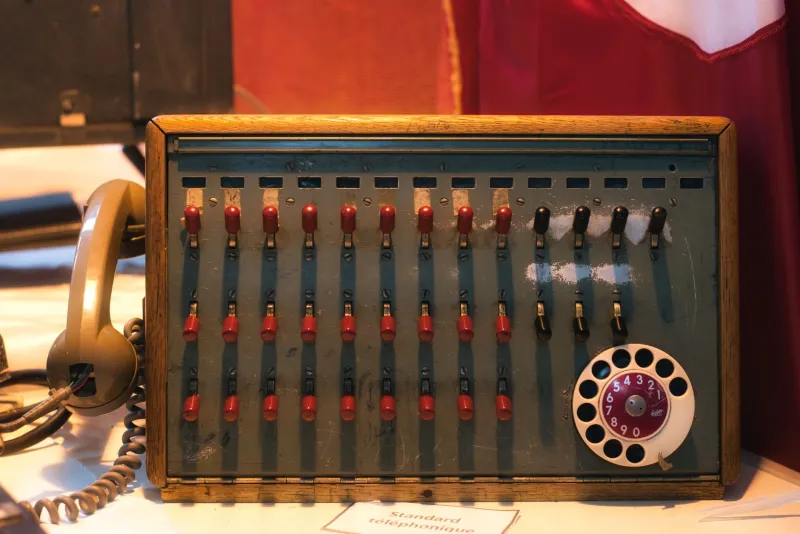
Switchboards, where they survive, are the obvious highlight. Early manual boards — the ones staffed by operators who physically connected calls by inserting patch cords into jacks — are increasingly rare finds, but some smaller regional exchanges held onto legacy equipment well into the era when it had already become obsolete. Crossbar switching systems, which mechanically automated call routing starting in the 1940s, are more commonly encountered. These are extraordinary machines: rows of electromechanical switches that click and clatter through call connections using a grid of horizontal and vertical bars. Finding one in a decommissioned exchange, dusty but otherwise intact, is the kind of discovery that makes urban explorers genuinely giddy.
Later digital switching equipment — the DSAMs and DMS-100s that replaced all of it starting in the 1980s and 1990s — is less photogenic but no less interesting from a historical standpoint. These boxy beige cabinets represent the moment the telephone network stopped being a mechanical system and became a software problem, and their presence in an abandoned exchange marks the inflection point where the building's useful life effectively ended.
Why They Empty Out
The transition from copper-based circuit switching to fiber-optic packet-switched networks didn't just make old telephone equipment obsolete — it made most of the real estate obsolete too. A fiber node serving the same subscriber load as an entire mid-century central office can fit in a climate-controlled cabinet the size of a refrigerator. The massive, carefully climate-controlled equipment rooms that once hummed with crossbar switches and relay banks simply aren't needed anymore.
Telecom consolidation accelerated the process. After the 1984 AT&T breakup, the resulting Baby Bells spent the next two decades merging back together in various configurations, shedding redundant properties along the way. Verizon, AT&T (reformed), and CenturyLink — now Lumen Technologies — collectively own or have owned thousands of these legacy exchange buildings, and managing that portfolio has been an ongoing headache. Some were sold, some were converted to data centers or loft apartments, and some just... sat. Particularly in smaller cities and rural areas, the economics of redevelopment never quite penciled out, and the buildings joined the long list of things America built carefully and abandoned carelessly.
Finding Them, Accessing Them
One of the more interesting quirks of telephone exchange buildings is how findable they are, at least on paper. The old Bell System naming conventions — Murray Hill, Pennsylvania, Klondike, Butterfield — were published in phone directories for decades, and the buildings that housed those exchanges are a matter of public record. Telecom historians have documented many of them, and property records fill in the rest.
Actually getting inside is a different story. Active telecom companies take infrastructure security seriously even for buildings they've largely abandoned, and former exchange buildings often retain some live equipment — a fiber splice point, a few active copper pairs, a remote terminal — that keeps them technically operational and therefore secured. Explorers who've documented these spaces tend to be tight-lipped about methodology, which is pretty standard practice in the community.
What they do share, usually, are the photographs. And the photos are worth seeking out. The combination of brutalist or deco architecture, the alien geometry of cable distribution frames, the ghostly presence of switchboards that once carried millions of conversations — it produces images that feel genuinely unlike anything else in the urban exploration catalog.
A Signal Worth Chasing
There's something philosophically interesting about telephone exchanges as ruins. These buildings were built to facilitate human connection at a massive scale, engineered with extraordinary care to make sure that when you picked up a receiver anywhere in America, something on the other end would answer. Now they sit in silence, the connections they once managed having migrated to infrastructure that's invisible and distributed and entirely elsewhere.
For explorers, that contrast is part of the draw. The buildings are physical evidence of an era when the infrastructure of communication was something you could walk into, touch, trace with your hands from the street-level cable vault up through distribution frames to the switching equipment on the upper floors. Whatever replaces them won't leave ruins like this. The next generation of telecommunications infrastructure will simply dissolve into the background, leaving nothing worth photographing.
Which is one more reason to document what's still standing while there's still something left to find.