Vacancy Forever: Wandering the Crumbling Motor Lodges of America's Forgotten Highway Strips
There's a particular kind of silence that settles over an abandoned motel parking lot. It's not the silence of a forest or an empty field. It's the silence of a place that used to be loud — ice machines rattling, kids splashing in kidney-shaped pools, screen doors banging shut on summer evenings. When you stand in that lot now, broken asphalt heaving up around you like a slow earthquake, you feel the absence of all of it like a pressure change in the air.
Urban explorers have been quietly documenting these properties for years. From the old Route 66 corridor through New Mexico and Arizona to the faded strips hugging US-1 up the Eastern Seaboard, the motor lodge — that distinctly American invention — left behind a remarkable architectural legacy that's disappearing faster than most people realize.
How the Motor Lodge Was Born (and Why It Mattered)
The motor lodge didn't just happen. It was a direct response to postwar America's love affair with the automobile and the federal government's decision to fund a coast-to-coast highway system. When Eisenhower signed the Federal Aid Highway Act in 1956, he didn't just build roads — he created an entire ecosystem of roadside commerce. Gas stations, diners, tourist traps, and yes, motor lodges bloomed along every new corridor like wildflowers after rain.
The design language was deliberately welcoming. Single-story or two-story L-shaped or U-shaped layouts wrapped around a central courtyard. Parking right outside your room door — a radical convenience at the time. Swimming pools positioned for maximum visibility from the road, because a glittering pool was basically a billboard. And the signs. God, the signs. Towering pylons of neon and backlit plastic, often shaped like arrows, cowboys, rockets, or abstract atomic-age swoops, each one competing for the eyeballs of drivers doing sixty-five in the right lane.
For about two decades, this model absolutely worked. Families loaded up the station wagon and pointed themselves at the horizon. Independent motel operators built modest empires one property at a time. The American road trip wasn't just a vacation format — it was practically a civic religion.
What Changed Everything
A few things happened more or less simultaneously, and together they were catastrophic for the independent motor lodge.
First, the interstates got smarter — or at least more controlled. New highway exits were engineered with interchange clusters in mind, and those clusters increasingly belonged to franchise brands. Holiday Inn, Ramada, Best Western, and their competitors had figured out that standardization was a superpower. A traveler who'd stayed in a Holiday Inn in Ohio knew exactly what they were getting in Oklahoma. That predictability was worth a lot to road-weary families.
Second, air travel got cheap enough for the middle class to consider it a real option. Long-distance road trips started losing ground to flights, especially for vacations that used to mean crossing multiple states.
Third — and this one's underappreciated — the bypass happened. When new highway segments routed traffic around the edges of small towns rather than through their main strips, the motels that had thrived on that through-traffic were suddenly sitting on roads that led nowhere important. Some held on for years running skeleton operations. Others just… stopped.
What Explorers Actually Find Inside
This is where it gets genuinely fascinating, and it's why the urban exploration community keeps returning to these properties.
Motels that closed abruptly — sometimes due to an owner's death, a sudden financial collapse, or a highway rerouting that happened faster than anyone planned — often preserve their interiors in remarkable condition. Explorers in the Southwest have documented rooms where the original 1960s bedspreads are still folded on mattresses. Avocado-green bathroom tile. Rotary phones bolted to nightstands. Pegboard walls in the office still holding room keys on numbered hooks.
The kitschy décor that defined mid-century hospitality culture turns out to be surprisingly durable. Ceramic lamps shaped like hula dancers. Framed prints of local landmarks that nobody remembers. Carpet patterns so aggressively geometric they seem to vibrate even in decay. These objects feel almost archaeological now — physical evidence of a specific cultural moment when Americans believed that leisure itself was a kind of progress.
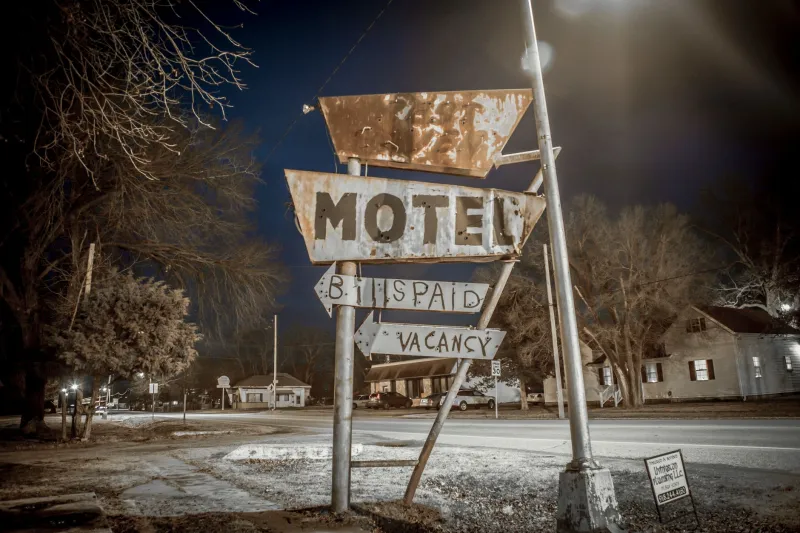
The signage is what draws a lot of explorers in the first place. Many of these properties still have their original signs standing, even if the electrical guts went dark decades ago. Porcelain panels, hand-painted letters, early plastic channel lettering — the craftsmanship is often extraordinary. Some signs have been partially stripped by scrappers or collectors, which gives them an eerie skeleton quality. Others are intact but frozen, their "VACANCY" or "NO VACANCY" indicators stuck permanently in whatever state they were in on closing day.
Regional Flavors Worth Knowing
Not all abandoned motor lodge territory is created equal, and the exploration community has developed a pretty solid mental map of where the richest finds are concentrated.
Route 66 Corridor — New Mexico and Arizona in particular. The density of mid-century commercial architecture here is unreal, partly because the economic decline was so sharp after I-40 bypassed the old alignment. Towns like Tucumcari, New Mexico are basically open-air museums of neon-era hospitality, and while some properties there have been deliberately preserved, plenty of others are still quietly falling apart at the edges of town.
US-1 in Florida — Before Disney rerouted the state's entire tourism geography, the stretch of US-1 through central Florida was lined with motor lodges catering to northerners heading south for the winter. Many of those properties are now in various states of abandonment or limbo, sitting on land that's become too valuable for what's on it but not quite valuable enough to have been redeveloped yet.
The Upper Midwest Strip Towns — Places along old US-2 or US-10 in Minnesota and Wisconsin that served as overnight stops for travelers heading to lake country. These tend to be smaller operations — ten or twelve units — and they often retain outbuildings like detached ice houses, equipment sheds, and laundry facilities that add real texture to a thorough exploration.
The Ethics of the Empty Lot
It's worth being straightforward about this: most of these properties are privately owned, even when they look completely abandoned. That ownership matters, and the exploration community generally takes it seriously. The standard guidance applies here — research ownership before approaching, never force entry, take nothing, leave nothing behind. Some of these sites are actively monitored even when they look completely forgotten.
That said, the documentation work being done by explorers on these properties has genuine historical value. Local historical societies and preservation organizations have increasingly recognized photography and video from explorers as important primary sources, especially for properties that are likely to be demolished before any formal documentation effort gets organized.
Why They Still Pull at Something in Us
There's an emotional weight to these places that's hard to fully articulate but easy to feel the moment you're standing in a room where someone's family spent a summer night in 1968. The motor lodge was a democratic space in a way that's almost quaint now — it asked very little of you beyond the nightly rate and promised very little in return beyond shelter and maybe a pool. The transaction was honest. The architecture was optimistic in a specifically American way, all forward momentum and chrome trim and the assumption that there would always be somewhere worth driving to.
That optimism is what makes the ruins feel melancholy rather than simply derelict. These weren't just buildings. They were infrastructure for a particular way of believing in the country — the idea that the road was always open and the next good thing was just ahead, past the next town, past the next neon sign winking at you from the dark.
Some of those signs are still out there, waiting for somebody to point a camera at them before they're gone for good.