Cubicle Crypts: What Urban Explorers Find When Corporate America Packs Up and Disappears
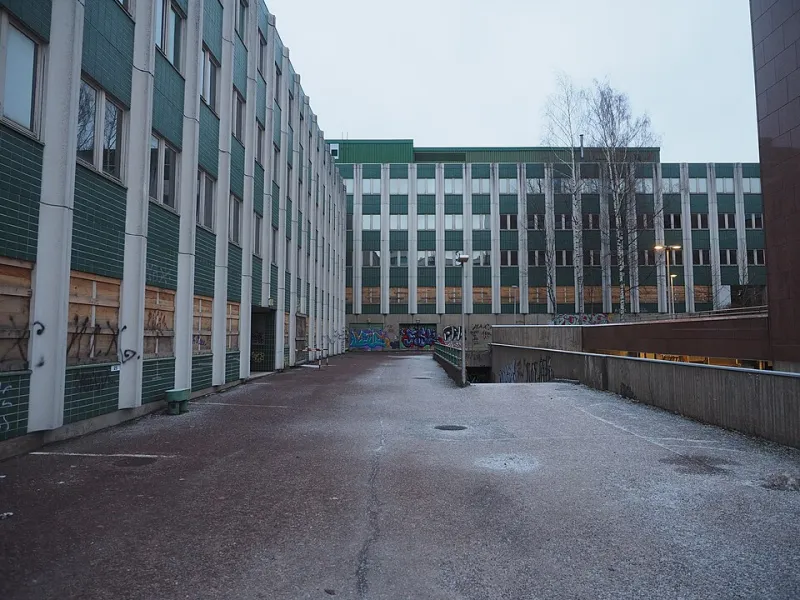
Photo: JIP, CC BY-SA 4.0, via Wikimedia Commons
There's something uniquely unsettling about an abandoned office. Unlike a shuttered factory or a crumbling hospital, the corporate workspace was never supposed to feel dangerous or dramatic. It was supposed to feel mundane — a place of coffee machines, quarterly reports, and motivational posters. Which is exactly what makes walking into one, years after the last employee badge-swiped out, so deeply strange.
Across the country's suburban fringes — the stretch of America that lives between the highway exit and the big-box strip — thousands of office parks have gone dark. Some were casualties of the 2008 financial collapse. Others folded during the pandemic, when remote work made entire campuses suddenly irrelevant. A few were simply outpaced by technology, their business models made obsolete before anyone thought to update the lobby directory. Whatever the cause, what they leave behind is a remarkably consistent tableau: an entire working world, frozen mid-sentence.
What's Actually Inside
The first thing most explorers notice is the paper. It's everywhere. Memos, printed email chains, HR policy handbooks, sales projections — whole filing cabinets worth of documentation left behind like a bureaucratic archaeological record. In one well-documented campus in northern New Jersey, explorers found an entire marketing department's pitch materials still arranged on a conference room table, as though the meeting had been scheduled for a Tuesday that never came.
Beyond the paper trail, the technology tells its own story. Cathode-ray monitors. IBM tower computers with floppy drives still loaded. Dot-matrix printers. Explorers documenting tech campuses in places like Silicon Valley's outer suburbs or the Research Triangle in North Carolina have stumbled onto server rooms that look like props from a mid-90s thriller — blinking lights, raised flooring, tangles of coaxial cable running into nowhere. These spaces are a physical record of how fast the tech world moves, and how completely it abandons what it outgrows.
Then there are the personal effects. Coffee mugs. Family photos still stuck to cubicle walls with pushpins. A half-finished crossword puzzle on a desk in Cincinnati. A child's drawing taped to a monitor in an empty Phoenix headquarters. The human residue of these places is what tends to hit explorers the hardest — the reminder that for the people who worked here, this wasn't just a building. It was a significant chunk of their daily lives.
The Architecture of Ambition
Office parks from the 1970s through the early 2000s were designed to project stability and permanence. Atrium lobbies with skylights. Manicured retention ponds. Granite reception desks. Campus-style layouts with walking paths between buildings, meant to evoke universities rather than warehouses. Developers sold these spaces to companies as statements of arrival — proof that your business had made it.
Walking through them now, that ambition reads as something closer to hubris. The lobbies that once impressed visiting clients now echo with dripping water and bird calls filtering through broken ceiling tiles. The motivational murals — the ones with soaring eagles and phrases like Excellence in Everything — peel from walls in strips. The koi ponds outside have gone green and wild.
Explorers with a taste for mid-century commercial architecture have found genuine gems in these complexes. Brutalist concrete poured into unexpected curves. Curtain-wall glass facades that still catch afternoon light beautifully despite years of grime. Interior courtyards that have quietly gone feral, moss and volunteer trees reclaiming what was once a curated corporate garden.
The Suburban Sprawl Factor
Most of these complexes exist in a particular American geography — the suburban office corridor. Think Route 128 outside Boston, the Dulles Technology Corridor in Northern Virginia, or the endless office-park belts ringing Dallas and Atlanta. These were built on the assumption that white-collar workers would always commute by car, always need a physical desk, and always want to do it in a campus environment far from urban centers.
That model collapsed faster than anyone predicted. Remote work didn't invent the problem — vacancy rates in suburban office markets were already climbing through the 2010s as companies consolidated into urban cores. The pandemic simply accelerated a trend that was already underway. The result is a geographic category of abandonment that's distinctly American: not the inner-city ruin, not the rural decay, but the suburban ghost campus, surrounded by functioning strip malls and chain restaurants, invisible to the commuters driving past it every day.
What Explorers Need to Know
Abandoned office complexes present a specific set of access challenges. Many are still technically owned by corporate entities or held by real estate investment trusts working through bankruptcy proceedings, which means the legal situation around trespassing can be murky and active. Security patrols are more common here than at more remote abandoned sites — some properties still have contracted guard services even when completely vacant.
Structurally, the hazards tend toward the mundane but still dangerous: asbestos insulation in older buildings, unstable drop ceilings, compromised flooring in basement server rooms where water has been pooling for years. Mold is a serious concern in any building that's been sealed and unventilated for an extended period, and former office parks are no exception.
That said, the exploration community has produced some remarkable documentation from these sites. Photographers working in the abandoned office spaces of the Rust Belt and mid-Atlantic have captured images that feel genuinely cinematic — the quality of light through grimy atrium glass, the geometry of empty cubicle farms, the surreal still-life of a desk left exactly as it was on someone's last day.
A Monument to a Particular Moment
What makes abandoned office parks worth exploring — beyond the obvious visual interest — is what they represent culturally. These were the physical infrastructure of a specific American economic era: the post-war corporate expansion, the suburban boom, the tech bubble, the belief that growth was the permanent default setting. Walking through them now is a way of reckoning with how quickly that certainty dissolved.
The cubicle farms that defined so much of 20th-century American work life are becoming ruins faster than anyone expected. And the explorers documenting them are doing something genuinely valuable — preserving a visual record of a world that corporate America has largely moved on from without looking back.