Dusty Dewey Decimals: What Explorers Find When America's Libraries Go Dark

Photo by Photo by Miguel Pinto on Unsplash on Unsplash
There's something uniquely unsettling about a library that no one uses anymore. Not the loud kind of unsettling you get crawling through a collapsed factory or squeezing past a rusted gate into an old asylum. It's quieter than that. More personal. Libraries were supposed to be quiet — but this kind of quiet is different. It's the quiet of abandonment, of community neglect, of a building that once held the sum of a town's intellectual ambitions left to mildew and pigeons.
Across the United States, hundreds of library buildings have been shuttered over the past several decades. Some are grand Gilded Age structures funded by Andrew Carnegie's famous philanthropy program. Others are mid-century modernist boxes that were cutting-edge in 1967 and eyesores by 2005. A surprising number are simply branch libraries — neighborhood institutions that fell victim to municipal budget cuts, declining foot traffic, or the quiet assumption that Google made them obsolete. Whatever the reason, explorers who push through the doors of these places tend to come away changed by what they find.
The Carnegie Legacy, Left to Rot
Between 1883 and 1929, Andrew Carnegie funded the construction of over 2,500 libraries worldwide, with nearly 1,700 of those built right here in the US. He believed public libraries were the great equalizer — free knowledge for anyone willing to walk through the door. It's an idea that still resonates. Which makes it all the more jarring when you find one of those buildings boarded up, its neoclassical columns crumbling, its arched windows dark.
Explorers who've documented Carnegie libraries in states like Pennsylvania, Ohio, and Indiana describe interiors that feel almost ceremonial in their decay. High ceilings with ornate plasterwork. Wrought iron staircases spiraling up to mezzanine reading galleries. Wooden circulation desks that smell like old varnish and dust. In some cases, the books are still there — not just a few scattered volumes, but full shelves, arranged in order, as if the librarian just stepped out for lunch and never came back.
One frequently photographed site in a small Ohio mill town still has its original card catalog intact, each tiny drawer labeled in faded typewriter ink. Explorers have pulled those drawers open to find cards referencing books that are still on the shelves twenty feet away. The whole system — designed to connect reader to knowledge — is still technically functional. It just has no readers.
Budget Cuts and Brutalism
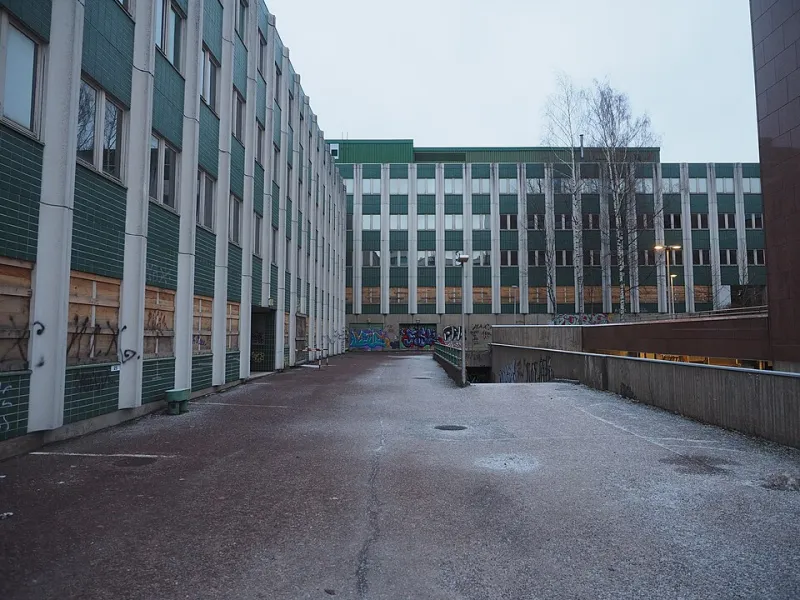
Not every abandoned library is a beauty. The postwar decades produced a wave of library construction that favored function over form — flat roofs, exposed concrete, floor-to-ceiling glass walls that made heating and cooling a nightmare. Many of these buildings aged poorly, both aesthetically and structurally. When municipalities started tightening belts in the 1980s and again after 2008, these utilitarian branches were often the first to go.
Explorers tend to have a complicated relationship with brutalist library ruins. The buildings aren't romantic in the traditional sense — no carved stone, no vaulted ceilings — but there's something compelling about watching nature reclaim a structure that was always a little cold to begin with. Ceiling tiles collapsed onto linoleum floors. Water stains blooming across concrete walls in shades of brown and rust. Fluorescent light fixtures hanging at odd angles, their tubes long since shattered.
What makes these spaces interesting isn't the architecture. It's the stuff left behind. Children's programming posters still tacked to bulletin boards. A half-finished book return cart, frozen mid-task. A community room with folding chairs still arranged in a circle, as if a meeting was expected that never happened. These branch libraries were neighborhood hubs — places people brought their kids on Saturday mornings, attended GED classes, used the only public computer terminal for miles. Walking through one that's been shuttered for a decade feels less like exploring a ruin and more like reading a community's obituary.
What the Shelves Actually Tell You
One of the more unexpectedly fascinating aspects of abandoned library exploration is what the surviving collections reveal about the communities they served. Explorers with a sharp eye for this stuff have noticed patterns that are genuinely illuminating.
In rural agricultural regions, you'll often find disproportionately large sections on farming, livestock management, and rural economics — practical knowledge for working communities. Urban branches sometimes show heavy holdings in vocational training, ESL materials, and civil rights history. A shuttered library in Appalachia might have an entire wall dedicated to local genealogy and regional history, the kind of hyper-specific knowledge that was never going to migrate to the internet.
These collections are snapshots. They document what a community valued, what it needed, what it aspired to. And in many cases, that documentation is now literally rotting. Books that survived decades of circulation are being destroyed by water infiltration, mold, and pests because no one had the budget or the will to relocate them before the building was locked up. It's a preservation crisis that doesn't get nearly enough attention.
The Ghosts of Programming Past
Beyond the shelves, explorers frequently encounter the remnants of library programming — the community-facing side of these institutions that often gets overlooked when people think about what libraries actually did.
Story time rooms with hand-painted murals still bright on the walls. Summer reading program banners drooping from ceiling mounts. A puppet theater, its curtain faded but intact, in the children's wing of a Pennsylvania branch that closed in 2011. These details hit differently than the books do. They're a reminder that libraries weren't just storage for information — they were active, living community spaces, often the only free, publicly accessible gathering place in a given neighborhood.
Finding these spaces abandoned carries a particular weight in the current moment, when debates about public institutions, community investment, and who gets access to knowledge feel more urgent than ever. An abandoned library isn't just an interesting ruin. It's a pretty pointed statement about what we decided wasn't worth maintaining.
Getting In and Staying Safe
As always, the practical stuff matters. Abandoned libraries present a few specific hazards worth knowing about. Older buildings — particularly pre-1980s structures — may contain asbestos in floor tiles, ceiling materials, or pipe insulation. Mold is an almost universal concern given the moisture sensitivity of paper and the tendency of these buildings to develop roof and window leaks. Structurally, the biggest risk in Carnegie-era buildings is often the upper floors and mezzanines, where wood framing may have deteriorated significantly.
Check local ordinances before you go anywhere. Many shuttered library buildings are still technically city or county property, which means trespassing laws apply even if the place looks completely abandoned. Some communities have active preservation groups working to repurpose these structures — connecting with those groups can sometimes yield legitimate access and a much richer understanding of what you're walking into.
Bring a good flashlight, watch where you step, and maybe — just this once — pick up a book while you're there. Some of them are worth saving.