Dome of Silence: What Explorers Discover Inside America's Abandoned IMAX Theaters and Science Museum Planetariums
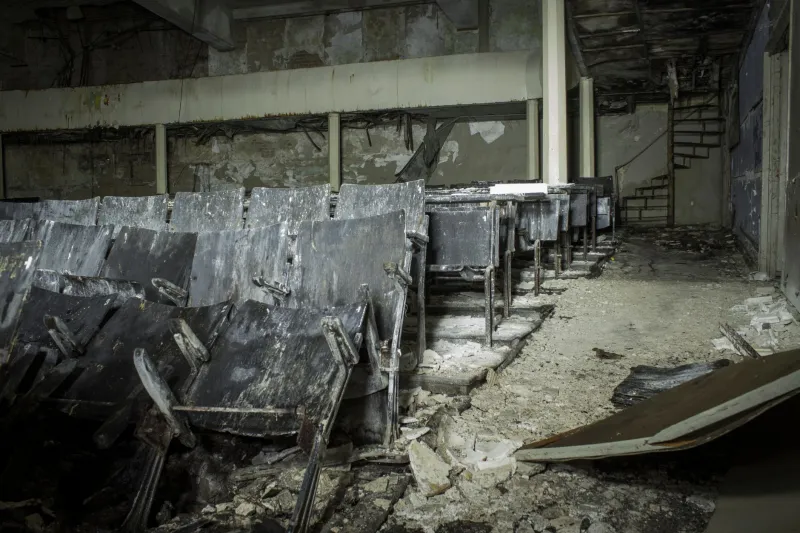
There's a particular kind of silence that lives inside a dead dome theater. It's not the regular quiet of an empty building — it's something more total, more geometric. Sound behaves differently in a sphere. It wraps around you, doubles back on itself, and then just... stops. When that dome used to be packed with school kids watching a 70mm film about the ocean floor or a laser show set to Pink Floyd, the acoustics were a feature. Now they just make the emptiness feel louder.
Across the United States, a surprising number of IMAX-format theaters and science museum dome facilities have quietly closed over the past two decades. Some were attached to natural history museums that ran out of operating budget. Others were standalone IMAX venues that couldn't survive the transition to multiplexes with their own "premium large format" screens. A handful were planetariums that lost their institutional funding after school district budget cuts gutted field trip programs. Whatever the reason, the result is the same: enormous, specialized, architecturally unusual buildings sitting empty, with some of the most distinctive projection equipment in the entertainment world gathering dust inside.
Urban explorers who manage to get into these spaces tend to describe the experience as unlike anything else in the abandoned-building circuit. The geometry alone is disorienting. You're not just walking through a dead building — you're standing inside a dead machine.
The Architecture of Awe (Gone Wrong)
IMAX and dome theaters were never built to be subtle. The whole point was scale — overwhelming, slightly terrifying scale. A standard IMAX dome screen can measure 60 to 80 feet in diameter, curving up and over the audience like the inside of a massive egg. The projection booth, when you find it, is usually a cramped room crammed with equipment that looks like it belongs in a NASA facility rather than a suburban science center.
Explorers who've documented these spaces often note how the architecture itself telegraphs the ambition that went into building them. Reinforced concrete ribs. Soundproofing layers thick enough to muffle a freight train. Ventilation systems engineered to quietly move enormous volumes of air without creating any noise that might compete with the film. These buildings were overengineered in the best possible way, which also means they're expensive to maintain and nearly impossible to repurpose.
That repurposing problem is a big part of why so many of them are just... sitting there. You can't easily convert a dome theater into an office. You can't subdivide it into retail space. The building is fundamentally shaped around one very specific use, and when that use goes away, the building tends to follow it into obsolescence — at least on paper. In practice, the concrete stays standing for a very long time.
The Projection Rigs Nobody Could Move
If the dome is the body of these spaces, the projection equipment is the heart — and it's usually still there. IMAX projectors from the 1980s and 1990s are genuinely massive pieces of machinery. The 15/70 format projectors used in dome theaters weigh several hundred pounds and are mounted on custom gimbals that allow the image to be thrown across a curved surface without distortion. Removing one requires specialized rigging, significant structural work, and usually a buyer willing to pay for the extraction. When an institution closes without a plan, that equipment just stays put.
Explorers document these projectors with almost reverential attention, and it's not hard to understand why. There's something genuinely impressive about a machine that was purpose-built to do one thing at enormous scale and then just stopped. Film reels, if they haven't been removed, are sometimes still threaded through the gate. Canisters of 70mm film stock, heavy and oxidizing slowly in the dark, line the shelves of projection booths like artifacts from a previous civilization.
The control systems are their own archaeological layer. Pre-digital dome theaters used elaborate analog switching boards to control not just the projector but the lighting sequences, the audio channels, and in some cases motorized elements of the set design. Finding one of these boards intact — with its rows of physical switches and hand-labeled tape — is the kind of discovery that makes explorers stop and photograph every inch of it.
The Exhibits That Never Got Packed Up
Many of the dome theaters that have gone dark were embedded in larger science museum complexes, and that means explorers often find more than just the theater itself. The surrounding exhibit halls — the ones that used to contextualize whatever documentary was playing on the dome that semester — are frequently in various states of mid-abandonment.
Interactive science exhibits from the 1990s and early 2000s have a specific aesthetic that's become its own flavor of nostalgia. Chunky touchscreens with resistive displays. Backlit photo panels explaining plate tectonics. Physical models of the solar system suspended from ceilings on metal wire, planets still hanging in their orbits, dusty and slightly faded. Push-button audio stations where, if you press the button, nothing happens anymore because the speaker system was disconnected years ago.
There's something genuinely affecting about a children's science exhibit that's been left to decay. These spaces were designed to inspire curiosity in kids, to be the place where someone first got excited about astronomy or marine biology or the age of the dinosaurs. Finding them empty and deteriorating carries a specific kind of melancholy that even seasoned explorers tend to mention.
Why They Closed
The story of how these places ended up abandoned is usually some combination of three forces: funding shortfalls, format obsolescence, and competition from home entertainment.
Many science museum dome theaters were built in the 1970s and 1980s with a combination of federal grants, corporate sponsorships, and municipal investment. The logic was that giant-screen educational films were a public good — a way to make science accessible and exciting for communities that didn't have access to natural wonders firsthand. That logic held up for a while. Then the grants dried up, the corporate sponsors moved on to newer branding opportunities, and the municipal budgets got squeezed.
At the same time, the IMAX brand itself went through a complicated evolution. The original large-format 70mm presentation was genuinely different from a regular movie theater experience. But as the format got licensed to multiplexes and the screen sizes got standardized downward, the premium feel eroded. Why drive to a science museum to see a nature documentary when your local AMC has an "IMAX" screen showing the same Marvel movie you were going to see anyway?
The home entertainment piece is harder to quantify but probably real. Giant screens, surround sound, and high-definition video became accessible at home in ways that were unimaginable when most of these dome theaters were built. The experiential gap that justified a special trip narrowed considerably.
Getting In and Getting Out
Access to these spaces varies wildly. Some former science museum buildings are actively monitored, particularly if the institution is technically still operating in a reduced capacity or if the building is owned by a municipality that occasionally checks on it. Others have been effectively forgotten, sitting on the edge of institutional campuses with their utility connections cut and their security presence reduced to a single padlock on a side door.
Explorers consistently flag the structural considerations specific to dome buildings. The curved concrete shells are generally extremely durable, but the internal fittings — suspended lighting rigs, projection mounts, catwalks — can be in much worse shape than the building envelope suggests. Corrosion on metal hardware is common, especially in humid climates. The projection booth areas, which were often sealed and climate-controlled when operational, can develop significant moisture problems once the HVAC systems stop running.
The reward for careful navigation, though, is access to some of the most visually distinctive spaces in the entire urban exploration catalog. Standing on the floor of a dead dome theater and looking up at 80 feet of curved screen above you, with a dormant projection rig hanging in the middle distance and the ghost of a thousand school field trips hanging in the air — that's an experience that's genuinely hard to replicate anywhere else.
These buildings were built to make people feel small in the best possible way. Even empty, they still do.